 Mueen Studio
Choosing between a rigid box and a folding carton is one of the first packaging decisions a brand makes, and one of the most expensive to get wrong. Pick a rigid box for a product that needed a carton and your margins disappear in unit and shipping costs. Pick a carton for a product that needed a rigid box and the unboxing feels cheaper than the price tag. Here’s the difference, plainly.
What is a folding carton?
A folding carton is made from a single sheet of paperboard that is printed, cut and creased, then folded into shape. It ships to you flat, gets folded and glued on a packing line or by hand, and closes with tuck flaps or a lock bottom. Think cereal boxes, cosmetics cartons, supplement boxes and most retail packaging on a pharmacy shelf.
The artwork prints directly onto the board, on one continuous dieline with panels, flaps and a glue area. Mailer boxes are a close cousin: usually made from corrugated board, but built and designed the same way, as one flat sheet that folds up.
What is a rigid box?
A rigid box, sometimes called a set-up box, is built from thick greyboard (chipboard) that does not fold. The board is cut into panels and assembled, then wrapped in printed paper that turns in over the edges. Common styles are:
- Lid and tray (lid and base): two separate parts; the lid lifts off.
- Magnetic closure: a hinged lid with magnets hidden under the wrap, which closes with a satisfying snap.
- Drawer (slide) box: a tray that slides out of a sleeve.
- Gift and book-style boxes, often with ribbons, windows or custom inserts.
Most rigid boxes arrive at your warehouse already assembled, which matters for storage and freight. Some magnetic boxes are made collapsible so they can ship flat and be set up by hand.
Side-by-side comparison
| Folding carton | Rigid box | |
|---|---|---|
| Material | Single sheet of paperboard (or corrugated for mailers) | Thick greyboard wrapped in printed paper |
| How it arrives | Flat, folded on the packing line | Usually assembled; some styles collapsible |
| Unit cost | Lower, and drops fast with volume | Higher; more materials and hand assembly |
| Storage and freight | Compact | Bulky, unless collapsible |
| Feel | Light, practical, retail-ready | Heavy, solid, gift-like |
| Reuse | Usually discarded | Often kept, which keeps the brand in the home |
| Best for | Supplements, cosmetics, food, retail shelves, high volume | Premium gifts, electronics, jewellery, kits, hampers, PR boxes |
| Artwork set-up | One dieline with panels, flaps and glue area | Separate wraps for lid and tray, plus insert and finishes |
How the design work differs
Designing a folding carton
Every panel is on one flat dieline, so the job is about panel order and orientation. The front panel needs to work on shelf, side panels carry claims and facts, the glue flap stays clear of important artwork, and tuck flaps need artwork that reads the right way up once folded. On the Timeless Radiance collagen carton, benefit claims, five ingredient infographics, two study summaries, usage, warnings and a QR code all had to fit on panels of 155 mm and 124.5 mm.
Designing a rigid box
A rigid box is a set of parts: a wrap for the lid, a wrap for the tray, often an insert, and sometimes a sleeve. Each wrap needs turn-in allowances where the paper folds over the board edge, and artwork has to line up across corners once wrapped. The inside of the lid is a design surface too; it’s the first thing seen on opening.
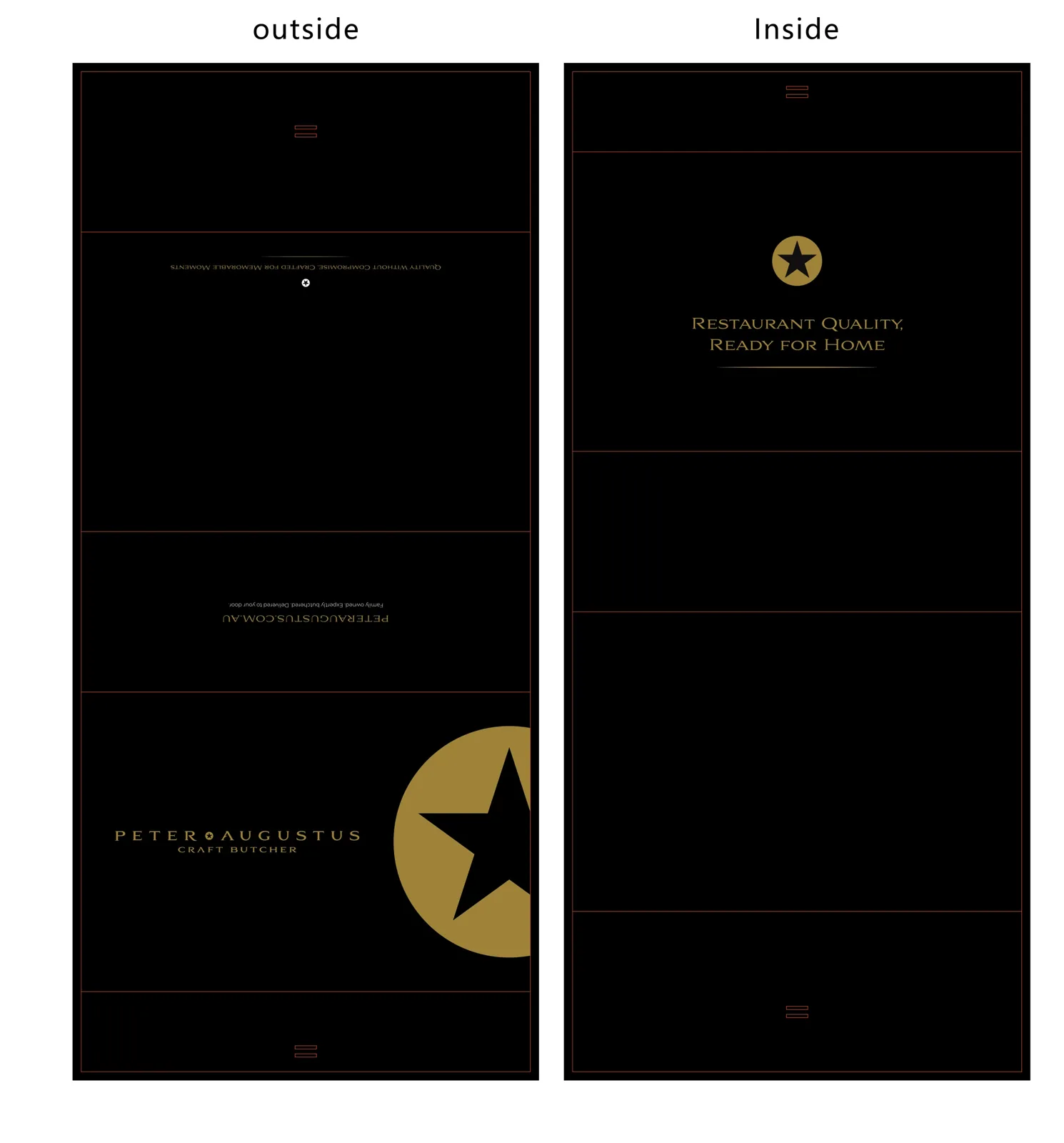
In the Peter Augustus case study, a 420 × 280 × 150 mm magnetic closure box for an Australian craft butcher, the exterior carries a cropped gold star on black, while the inside of the lid holds the line “Restaurant Quality, Ready for Home” for the opening moment. The tray continues the black treatment with a subtle tonal star. The handoff included editable AI source, print-ready AI and PDF files for the wrap and tray, flat previews and a 3D render.
Which should you choose?
Choose a folding carton if:
- the product sells on a retail shelf alongside competitors;
- you need volume at a low unit cost;
- storage space and freight cost matter more than the unboxing;
- the product is light, such as supplements, cosmetics or food.
Choose a rigid box if:
- the price point justifies a premium unboxing, as with gifts, hampers or luxury goods;
- the product is heavy or fragile and needs a firm structure and a custom insert;
- the box will be kept and reused;
- it’s a PR, influencer or subscription box where the opening is part of the product.
There’s a middle path as well. A well-designed folding carton with foil, emboss and spot UV can look premium at carton cost, and a mailer box with a printed inside gives e-commerce brands an unboxing moment without rigid-box freight.
Going premium? See magnetic, lid-and-tray, drawer and gift boxes on the rigid box packaging design page. Going retail? See cartons, mailers and display boxes, $250–350.
Before you decide, talk to your manufacturer
Ask your manufacturer for unit prices on both options at your real order quantity, and for their dieline. Then design on that dieline. I design structure and graphics together, so whichever box you choose, the artwork lands on the right panels and the files are ready for the factory.